Dental Suture Selection Chart: Choose the Right Suture for Every Procedure (MS-GUIDE-DENTAL-SELECTION-008)
Please enquire
Buy MS-GUIDE-DENTAL-SELECTION-008 - Dental Suture Selection Chart: Choose the Right Suture for Every Procedure online from us for just Please enquire, contact us for bulk and wholesale orders.
A practical dental suture selection chart outlining recommended materials and sizes for extractions, implant surgery, periodontal flaps and GBR procedures to support predictable wound healing outcomes.
Dental Suture Selection Chart: Choose the Right Suture for Every Procedure
Quick answer: Dental suture selection depends on procedure type, tissue tension, healing time and plaque retention risk. Absorbable sutures are commonly used for routine closures, while monofilament non-absorbable sutures may be preferred where precise flap stability and minimal bacterial wicking are required.
On this page:
Dental Suture Selection Chart
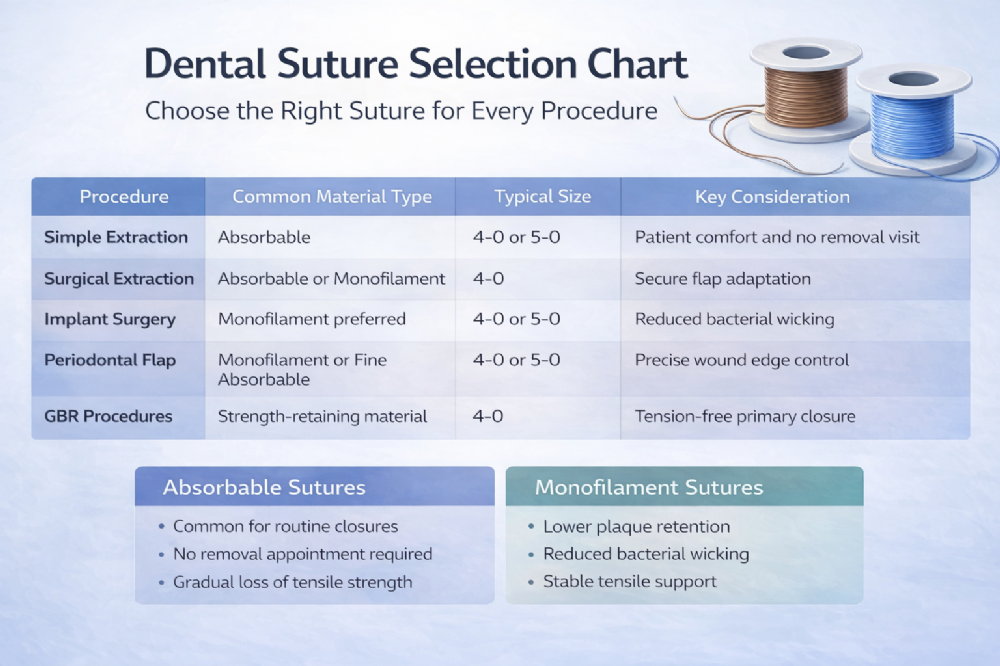
| Procedure | Common Material Type | Typical Size | Key Consideration |
|---|---|---|---|
| Simple Extraction | Absorbable | 4-0 or 5-0 | Patient comfort and no removal visit |
| Surgical Extraction | Absorbable or Monofilament | 4-0 | Secure flap adaptation |
| Implant Surgery | Monofilament preferred | 4-0 or 5-0 | Reduced bacterial wicking |
| Periodontal Flap | Monofilament or Fine Absorbable | 5-0 or 6-0 | Precise wound edge control |
| GBR Procedures | Strength-retaining material | 4-0 | Tension-free primary closure |
How to Interpret the Chart
This chart provides general clinical guidance. Final suture selection depends on tissue thickness, wound tension, patient hygiene and healing time. In most cases, clinicians aim to use the smallest diameter suture that provides adequate wound support.
Absorbable vs Monofilament in Dentistry
Absorbable Sutures
- Common for routine closures
- No removal appointment required
- Gradual loss of tensile strength
Monofilament Sutures
- Lower plaque retention
- Reduced bacterial wicking
- Stable tensile support
Conclusion
Dental suture selection should be procedure-specific. Extraction closures prioritise comfort, implant and periodontal procedures require stable flap control, and GBR demands reliable tension-free closure. Using the appropriate size and material improves healing outcomes and surgical predictability.
Loading...
Loading...