Dental Suture Techniques Explained | Oral Surgery Guide (MS-GUIDE-DENTAL-TECHNIQUES-015)
Please enquire
Buy MS-GUIDE-DENTAL-TECHNIQUES-015 - Dental Suture Techniques Explained | Oral Surgery Guide online from us for just Please enquire, contact us for bulk and wholesale orders.
A clinical guide outlining common dental suture techniques including interrupted, continuous, mattress, sling and figure-of-eight sutures for oral surgery and implant procedures.
Dental Suture Techniques: Clinical Guide for Oral Surgery
Direct answer: Dental suture techniques are used to stabilise soft tissue flaps, control bleeding and promote predictable healing following extractions, implant placement and periodontal surgery. The most common techniques include interrupted, continuous (running), vertical mattress, horizontal mattress, sling and figure-of-eight sutures.
Why Dental Suture Technique Matters
Proper suturing technique directly influences flap stability, wound tension distribution, clot retention and post-operative healing outcomes. In oral surgery, technique selection must consider tissue thickness, vascularity and the presence of implants or regenerative materials.
- Maintains flap adaptation
- Reduces wound tension
- Improves clot stability
- Minimises dehiscence risk
- Supports predictable healing
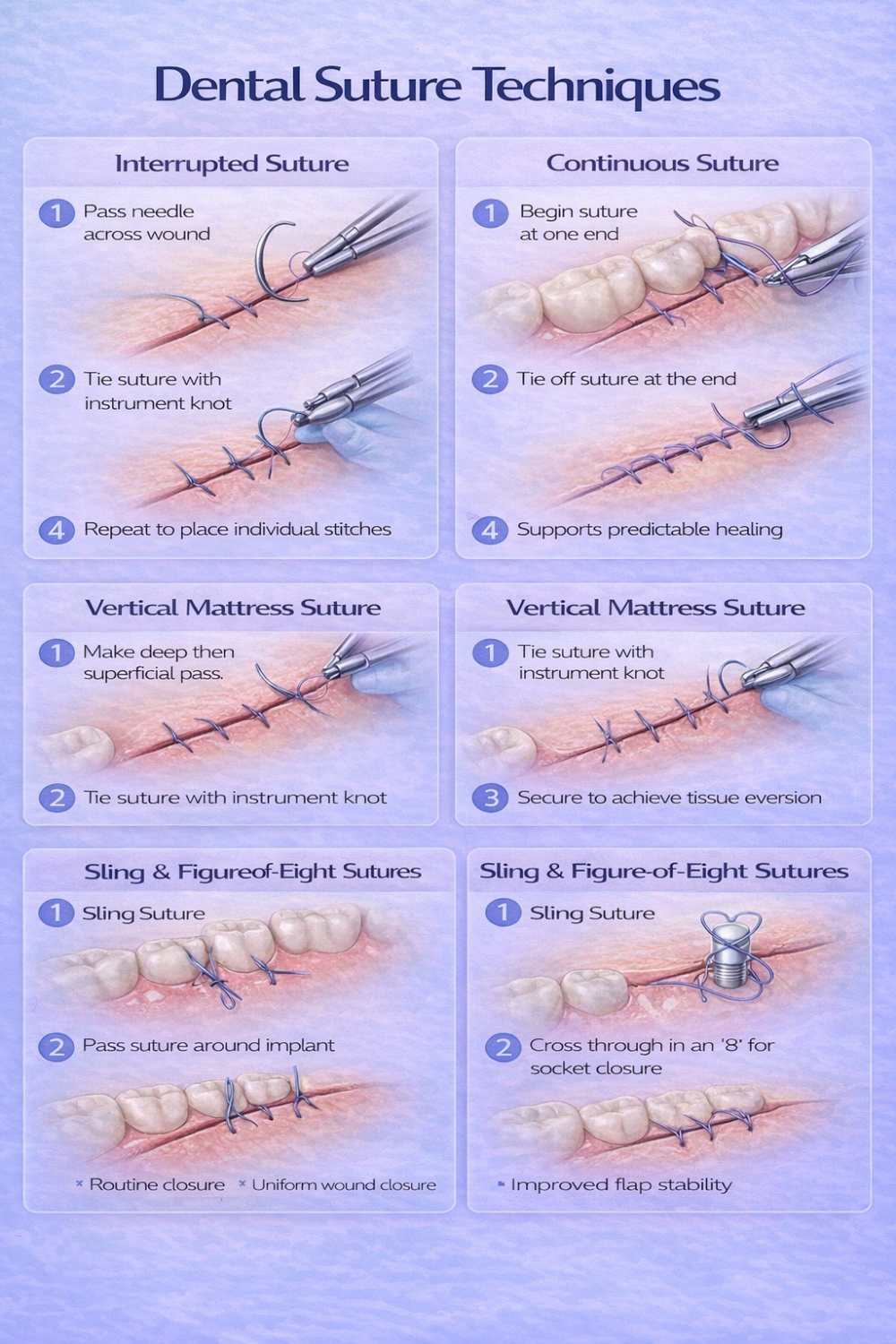
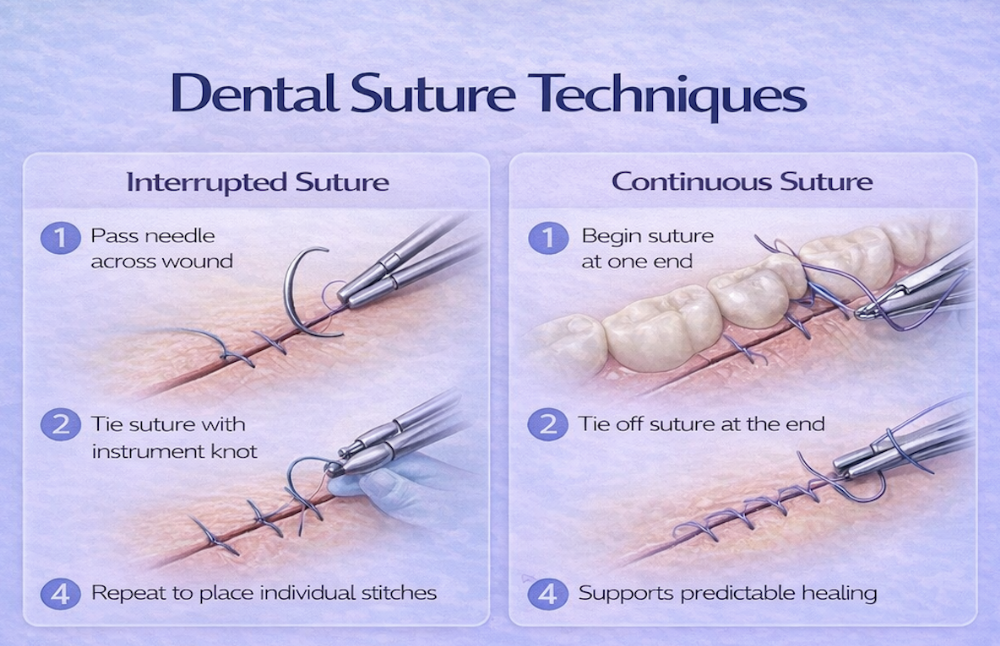
1?? Simple Interrupted Suture
The interrupted suture is the most commonly used dental closure technique.
Indications
- Routine extractions
- Small surgical flaps
- Low to moderate tension wounds
Advantages
- Independent stitch control
- If one knot fails, others remain secure
- Simple placement technique
2?? Continuous (Running) Suture
A single strand runs along the incision without tying individual knots.
Indications
- Long incision lines
- Uniform tension closure
- Rapid flap approximation
Considerations
- Faster placement
- Even tension distribution
- If broken, entire closure may loosen
3?? Vertical Mattress Suture
The vertical mattress technique passes deep-to-superficial and superficial-to-deep to evert wound edges.
Indications
- Implant surgery
- GBR procedures
- High-tension flaps
Advantages
- Excellent wound edge eversion
- Strong tissue approximation
- Improved flap stability
4?? Horizontal Mattress Suture
This technique distributes tension horizontally across the wound.
Indications
- Fragile tissue
- Wide surgical flaps
- Areas at risk of tearing
Advantages
- Spreads tension evenly
- Reduces tissue cut-through risk
5?? Sling Suture
The sling suture is frequently used in periodontal and implant procedures to secure tissue around a tooth or implant.
Indications
- Periodontal flap surgery
- Implant abutment stabilisation
- GBR flap positioning
Advantages
- Precise papilla control
- Improved soft tissue contour
6?? Figure-of-Eight Suture
This crossed pattern is commonly used for extraction socket closure and haemostasis.
Indications
- Post-extraction bleeding control
- Socket graft stabilisation
Advantages
- Provides compression
- Supports clot retention
Dental Suture Technique Comparison
| Technique | Best For | Tension Control | Flap Stability |
|---|---|---|---|
| Interrupted | Routine closure | Moderate | Good |
| Continuous | Long incisions | Even distribution | Moderate |
| Vertical Mattress | High tension flaps | High | Excellent |
| Sling | Implant & perio | Targeted | Very high |
| Figure-of-Eight | Extraction sockets | Compression | Moderate |
Conclusion
Dental suture technique selection should match the surgical objective. Interrupted sutures remain versatile for routine closure, while vertical mattress and sling techniques provide enhanced stability in implant and regenerative procedures. Proper technique improves flap control, reduces complications and supports optimal healing outcomes.
Loading...
Loading...