Medical Sutures, Unit 7, Latham Road Business Park, Latham Road, Huntingdon, Cambridgeshire, PE296YE
Customer Care:
Email: hello@medicalsutures.co.uk
 Medical Sutures
Please enquire
Buy MS-GUIDE-SKIN-CLOSURE-006 - Best Sutures for Skin Closure: Absorbable vs Non-Absorbable Explained online from us for just Please enquire, contact us for bulk and wholesale orders.
A clinical guide explaining the best sutures for skin closure, comparing absorbable and non-absorbable materials, cosmetic considerations, nylon versus polypropylene and recommended suture removal timing.
Quick answer: Non-absorbable sutures such as nylon or polypropylene are commonly preferred for skin closure because they provide reliable tensile strength and precise wound edge approximation. Absorbable sutures may be used in selected cases where removal is impractical or patient follow-up is uncertain.
For most routine skin closures, non-absorbable sutures are considered the standard choice. They provide consistent tensile strength during early wound healing and allow controlled removal once epithelialisation has occurred.
Absorbable sutures may be considered when:
However, absorbable sutures may provoke a greater tissue reaction depending on material and may lose strength before optimal skin support is achieved in high-tension wounds.
For optimal cosmetic outcomes, clinicians should consider:
Fine monofilament sutures such as 5-0 or 6-0 nylon are commonly used for facial closures due to reduced scarring risk and minimal tissue drag.
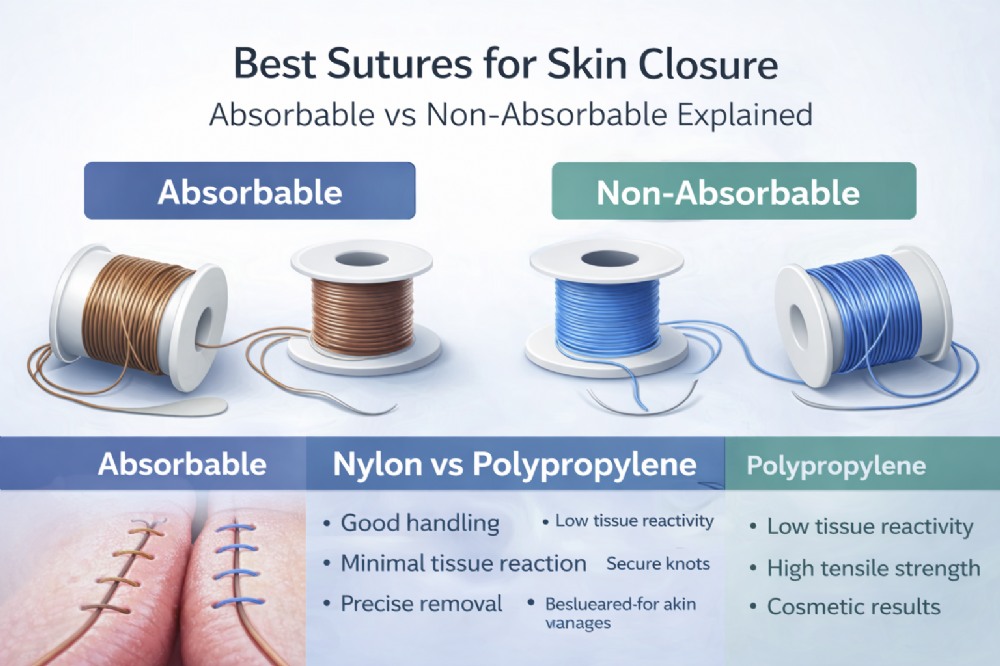
Both nylon and polypropylene are monofilament sutures and are appropriate for skin closure. Polypropylene may offer slightly lower tissue reactivity, while nylon is often praised for handling characteristics.
Suture removal timing depends on anatomical location:
Early removal reduces track marks and improves cosmetic outcome, but premature removal may increase wound dehiscence risk.
For most skin closures, non-absorbable monofilament sutures such as nylon or polypropylene provide predictable tensile strength and superior cosmetic control. Absorbable sutures may be suitable in selected cases, but careful clinical judgement is required to balance wound support with patient comfort and follow-up considerations.
Loading...
Loading...